Two Different Kinds of "Strong"
THCP and THCA are both called "strong" hemp cannabinoids, but they're strong in completely different ways. Understanding the difference matters because it affects your experience, your dose, and what products you should buy.
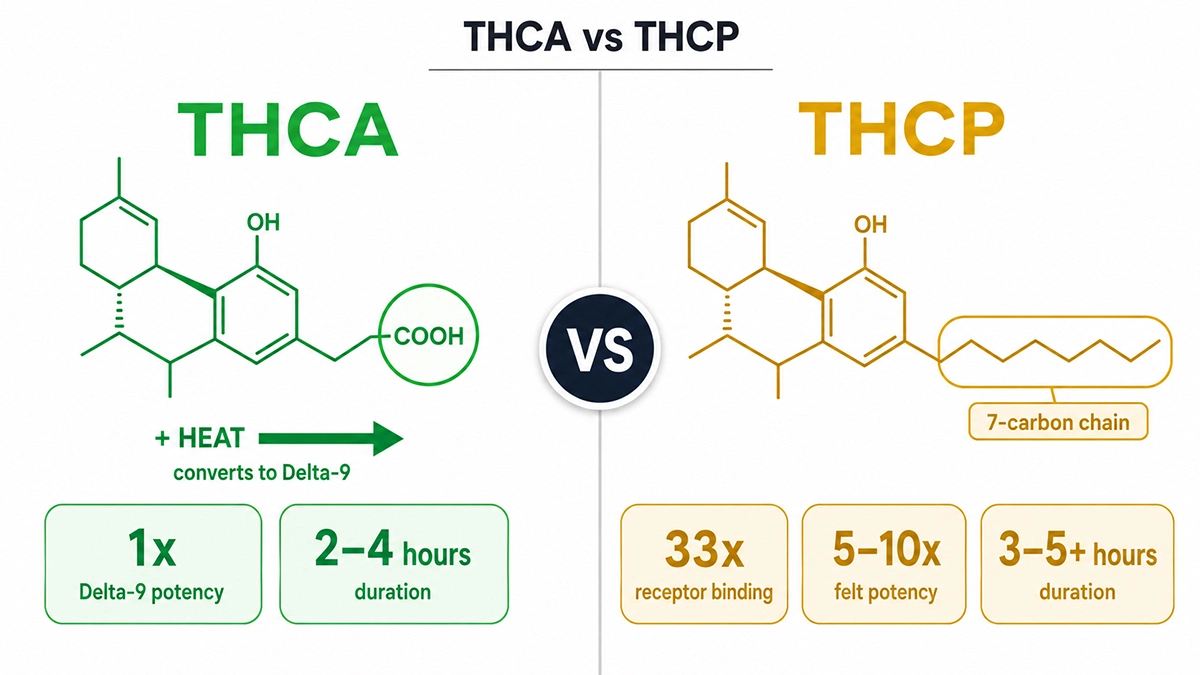
THCA is the precursor to regular Delta-9 THC. When you vape THCA, heat converts it to Delta-9 through decarboxylation. The result is a standard full-strength cannabis high: 1x Delta-9 potency.
THCP is its own cannabinoid with a longer alkyl side chain (7 carbon atoms vs. 5 for Delta-9). This structural difference gives THCP up to 33x greater CB1 receptor binding affinity than Delta-9. It doesn't produce 33x the high, but it produces significantly stronger, longer-lasting effects at much smaller doses.
One gives you Delta-9. The other gives you something stronger than Delta-9. Here's the full breakdown.
Head-to-Head Comparison
| Category | THCA (Vaped) | THCP |
|---|---|---|
| What It Actually Is | Precursor to Delta-9 THC | Unique cannabinoid (7-carbon chain) |
| Potency | 1x Delta-9 (converts when heated) | ~5-10x felt potency vs Delta-9 |
| CB1 Binding Affinity | Same as Delta-9 (after conversion) | 33x Delta-9 (Citti et al., 2019) |
| Onset (Vaped) | 1-5 minutes | 1-5 minutes |
| Duration | 2-4 hours | 3-5+ hours |
| High Type | Standard Delta-9: euphoric, relaxing | Intense, deep, long-lasting |
| Dosing | Standard cannabis dosing | Micro-dose: 0.3-3mg is plenty |
| Best For | Traditional cannabis experience | Experienced users seeking max potency |
| Drug Test | Yes | Yes |
| Federal Legality | Legal* (Farm Bill loophole closing Nov 2026) | Legal* (same) |
THCA Explained
THCA (tetrahydrocannabinolic acid) is the most abundant cannabinoid in living hemp and cannabis plants. Every plant that produces THC starts by producing THCA first. In its raw form, THCA isn't psychoactive. It can't effectively bind to your CB1 receptors because of its molecular shape.
But add heat, and everything changes. Decarboxylation strips a carboxyl group (COOH) from the THCA molecule, converting it directly into Delta-9 THC. This happens automatically when you vape (350-450F), smoke (600F+), or dab (500-700F). The conversion is nearly complete in a vape device.
After conversion, THCA and Delta-9 are the same thing. A 25% THCA vape cartridge delivers the same experience as a 25% THC dispensary cartridge. The high, the duration, the side effects: all identical.
For a deeper look at how decarboxylation works, check our THCA effects guide.
THCP Explained
THCP (tetrahydrocannabiphorol) was discovered in 2019 by Italian researchers (Citti et al., published in Scientific Reports). It's a naturally occurring cannabinoid found in very small concentrations in cannabis plants.
What makes THCP unique is its 7-carbon alkyl side chain. Standard Delta-9 THC has a 5-carbon chain. Those two extra carbons let THCP fit into CB1 receptors more deeply and bind more tightly. The research measured 33x greater binding affinity compared to Delta-9.
In practice, THCP doesn't produce 33x the subjective high. That 33x figure describes receptor binding, not the experience. Most users report THCP as 5 to 10 times stronger in felt effects compared to Delta-8, with a notably longer duration (3-5+ hours vs. Delta-8's 2-3 hours). Even at low doses, THCP hits harder and lasts longer than any other common hemp cannabinoid.
THCP is almost never sold as an isolate. It's too potent on its own. Most products blend it with Delta-8, HHC, CBN, or other cannabinoids to create a balanced experience. Every THCP product at Vape City USA uses multi-cannabinoid blends for this reason.
Dosing: Where the Difference Really Shows
This is the most practical difference between THCA and THCP. Getting the dose wrong with THCP can ruin your evening.
THCA Dosing (After Conversion to Delta-9)
Standard cannabis dosing applies. If you're comfortable with Delta-9 products, THCA at the same concentration will feel the same. Most vapers take 2-5 puffs per session and adjust from there. Beginners should start with 1-2 puffs and wait 10 minutes.
THCP Dosing
THCP requires significantly less product to achieve strong effects:
- First-time THCP user: 1 short puff (2 seconds). Wait 15-20 minutes. This delivers roughly 0.3-0.5mg of THCP.
- Beginner: 1-3mg per session. Two to three moderate puffs with breaks.
- Intermediate: 3-5mg per session.
- Advanced: 5-10mg per session. Even experienced users rarely need more.
The biggest mistake people make with THCP is treating it like Delta-8 and taking the same number of puffs. Don't do this. Start with one puff. Wait. Assess. Then decide if you need more.
THCP Products at Vape City USA
Every THCP product on our site uses a multi-cannabinoid blend formula. Pure THCP isolate would be too intense for most users.
- Uplift Knockout CDT Disposable: 2g, THCP + Delta-8 + CBN + HHC, Cannabis-Derived Terpenes. Best flavor accuracy.
- Uplift Knockout BDT Disposable: 2g, same Knockout Blend, Botanical Terpenes. Best budget option.
- Uplift Knockout Cart: 1g, 510-thread, same blend. Cheapest entry into THCP.
- Geek THCX GT6000: 6g, CB9A + THCP, live resin, dual mesh coils, 10 flavors. Best capacity per gram.
For full reviews and comparison tables, see our Best THCP Vapes 2026 roundup.
Drug Testing and Legal Status
Drug tests: Both THCA (once vaped) and THCP produce THC-COOH metabolites that trigger standard drug tests. Neither is "safe" for passing a screening. Full details in our drug test guide.
Legal status: Both are currently federally legal under the 2018 Farm Bill when derived from hemp with less than 0.3% Delta-9 THC. However, the Continuing Appropriations Act takes effect November 12, 2026, shifting to a total tetrahydrocannabinols standard with a 0.4mg per container cap. Both THCA and THCP count toward that total, which will affect most current products.
Some states have already banned THCA, THCP, or both under state-level regulations. Check the state-by-state legal guide before ordering.
Which One Should You Choose?
Pick THCA if:
- You want a standard Delta-9 cannabis experience from a legal hemp product
- You're familiar with traditional THC and want the same effects
- You prefer higher doses with predictable results
- You want pure flower or single-cannabinoid vapes
Pick THCP if:
- Standard Delta-9 isn't strong enough for you
- You want longer-lasting effects (3-5+ hours)
- You're comfortable with careful, low-dose consumption
- You want a multi-cannabinoid entourage experience
- You value value: THCP blends often cost less per effective dose because you use less
For a broader comparison of all hemp cannabinoids, see our complete cannabinoid encyclopedia.
Browse all hemp and THC products at Vape City USA. Every product is third-party lab tested and ships with COAs. Adults 21+ only.
Frequently Asked Questions
Is THCP stronger than THCA?
In felt effects, yes. THCA converts to regular Delta-9 THC when you vape it, so it gives a standard 1x cannabis high. THCP is its own cannabinoid that binds CB1 receptors far more tightly, and most users find it 5 to 10 times stronger than Delta-8 with a longer duration. THCP hits harder at much smaller doses than THCA.
What does THCP's 33x receptor binding mean?
It means THCP binds to your CB1 receptors about 33 times more tightly than Delta-9 THC, based on the 2019 research that discovered it. That's a measure of binding, not the size of the high. THCP doesn't make you 33x as high, but the strong binding is why even small doses produce intense, long-lasting effects.
How much THCP should a beginner take?
Start small. For your first time, take one short 2-second puff (about 0.3 to 0.5mg) and wait 15 to 20 minutes before deciding on more. A typical beginner session is 1 to 3mg. The most common mistake is treating THCP like Delta-8 and taking too many puffs at once, so go slow and assess.
Do THCP and THCA show up on a drug test?
Yes, both can. Once THCA is vaped it converts to Delta-9, and THCP is also broken down into THC-COOH metabolites, which are what standard urine, blood, saliva, and hair tests detect. Neither is safe for passing a screening. If you have a drug test coming up, don't use either one.
Are THCP and THCA legal?
Both are federally legal under the 2018 Farm Bill when derived from hemp with less than 0.3% Delta-9 THC. That changes on November 12, 2026, when a new total-THC standard takes effect, and both count toward the limit. Some states already restrict THCA, THCP, or both, so check your local rules before ordering.
These statements have not been evaluated by the FDA. These products are not intended to diagnose, treat, cure, or prevent any disease.