Two Cannabinoids, Very Different Experiences
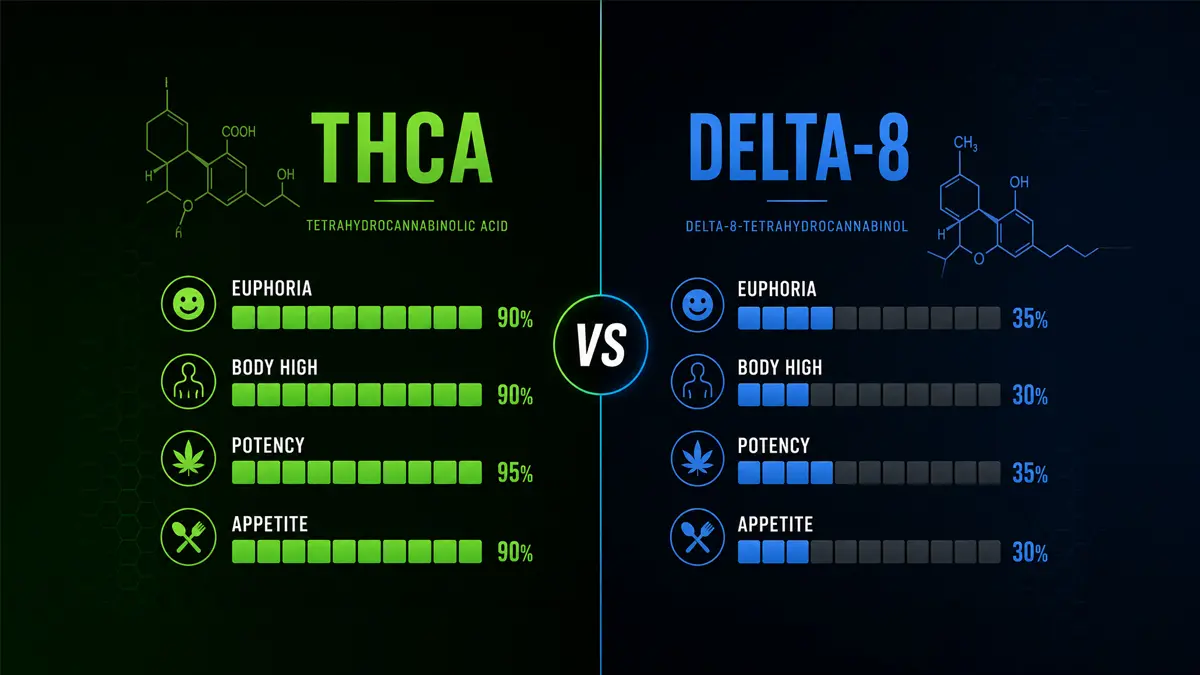
THCA and Delta-8 are the two most popular hemp-derived cannabinoids on the market right now, and they couldn't be more different. THCA converts to full-strength Delta-9 THC the moment you vape or smoke it. Delta-8 delivers about half that potency with a smoother, more clear-headed buzz. Same plant, same legal framework, completely different effects.
If you're trying to decide between the two, this comparison covers everything: potency, effects, how they're made, legality, drug testing, pricing, and which one matches your needs. No fluff, just the data.
The Full Comparison
| Category | THCA (When Heated) | Delta-8 THC |
|---|---|---|
| Potency | Full-strength (converts to Delta-9) | ~50% of Delta-9 |
| Effects | Euphoria, body high, altered perception, appetite boost | Mild euphoria, clear-headed relaxation, less anxiety |
| Onset (Vaped) | 1-5 minutes | 2-5 minutes |
| Duration | 2-4 hours | 2-5 hours |
| How It's Made | Natural. Cold-extracted from hemp flower. | Converted from CBD via chemical isomerization |
| Legal Status | Federal: legal (pre-decarb testing). Banned in ~12 states. | Federal: legal. Banned in 17-20 states. |
| Drug Test | Will cause a positive result | Will cause a positive result |
| Price Range | Carts: $15-60. Flower: $10-20/g | Carts: $15-30. Gummies: $15-30 |
| Best For | Experienced users, strong effects, pain relief | Beginners, daytime use, functional buzz |
| Formats | Flower, vapes, concentrates, gummies | Gummies, vapes, tinctures, capsules |
Potency: THCA Hits Twice as Hard
This is the biggest difference. When you vape THCA, heat triggers a chemical reaction called decarboxylation. The THCA molecule loses a carboxyl group and converts into Delta-9 THC at roughly 87.7% efficiency. A product with 25% THCA delivers about 22% Delta-9 THC after conversion. That's full-strength cannabis.
Delta-8 doesn't convert into anything. What you see on the label is what you get, and it binds to your brain's CB1 receptors about 40-50% less effectively than Delta-9. The result is a noticeable but manageable buzz. Most users describe Delta-8 as "diet weed" or "THC with the anxiety dialed down."
In practical terms: one puff of a THCA vape will hit roughly twice as hard as one puff of a Delta-8 vape at the same concentration. If you have a low tolerance or tend to get anxious from THC, that's a meaningful difference.
For an even deeper look at how THCA works, see Does THCA Get You High? What Actually Happens When You Vape It.
Effects: Full-Strength vs. Functional
THCA (heated) delivers the classic THC experience. Euphoria, body relaxation, heightened sensory perception, increased appetite, and altered sense of time. At higher doses, expect potential couch-lock and sedation, especially with Indica strains. It's the full ride.
Delta-8 feels like THC with the volume turned down. You get mild euphoria, gentle body relaxation, and a clear-headed quality that Delta-9 doesn't always provide. Many users can still work, socialize, and function normally on Delta-8 at moderate doses. The "functional high" is Delta-8's selling point.
Here's the key trade-off: THCA gives you stronger effects but carries a higher risk of anxiety and paranoia, especially for new users. Delta-8 gives you less intensity but more control over the experience. Neither is "better." It depends on what you're after.
How They're Made: Natural vs. Converted
This is where things get interesting, and it's something most comparison articles skip.
THCA is a natural cannabinoid. It occurs abundantly in raw cannabis and hemp plants. Extracting it requires cold methods (ethanol, CO2, or mechanical processing) that preserve the carboxyl group. No chemical conversion, no acids, no catalysts. What comes out of the plant is what goes into the product.
Delta-8 doesn't exist in significant natural quantities. Hemp produces trace amounts (less than 0.1%), so commercial Delta-8 is manufactured by converting CBD into Delta-8 through a process called isomerization. This involves acidic catalysts, solvents, and multiple purification steps. The conversion process can introduce byproducts and contaminants if not done carefully.
This matters for two reasons. First, product quality varies wildly in the Delta-8 market because not every manufacturer purifies their product thoroughly. Always check for a third-party Certificate of Analysis (COA) that tests for residual solvents, heavy metals, and unexpected cannabinoids. Second, the synthetic nature of Delta-8's production is one reason some states have banned it specifically.
THCA's natural origin is a trust differentiator. You're getting a compound that the plant made, not one that a lab created from CBD.
Legal Status in 2026
Both THCA and Delta-8 are currently federally legal under the 2018 Farm Bill, which defines legal hemp as cannabis containing less than 0.3% Delta-9 THC by dry weight. But state laws paint a different picture:
- THCA: Banned or restricted in roughly 12 states. The loophole works because labs test the raw product before decarboxylation, so high-THCA flower passes the Delta-9 threshold.
- Delta-8: Banned in 17-20+ states, including California, Colorado, New York, and Michigan. More states have explicitly targeted Delta-8 than THCA.
The big change coming: In November 2025, federal legislation redefined hemp to use a "total tetrahydrocannabinols" standard measured after decarboxylation. Enforcement begins November 12, 2026. This means THCA will count toward the 0.3% threshold, and finished products face a cap of 0.4mg total THC per container. Most current THCA flower and many Delta-8 products won't qualify as legal hemp after that date.
Both cannabinoids are on borrowed time at the federal level. Check your state laws before ordering, and understand that the landscape is shifting. Full details in our state-by-state legal guide.
Drug Tests: Both Will Fail You
There's no sugarcoating this. Both THCA and Delta-8 will cause a positive result on a standard drug test.
When your body metabolizes Delta-9 THC (from heated THCA) or Delta-8 THC, it produces the same metabolite: THC-COOH. That's exactly what urine tests look for. The test can't tell whether the THC came from a dispensary, a THCA vape, or a Delta-8 gummy. All roads lead to the same metabolite.
Detection windows for occasional use run 3-15 days. Daily use pushes it to 30 days or more. Heavy, long-term use can keep metabolites detectable for 60-90 days because THC-COOH is fat-soluble and builds up in tissue.
If you have a drug test on the horizon, neither THCA nor Delta-8 is safe. Full breakdown in our drug test guide.
Who Should Choose THCA
- Experienced cannabis users who want the full Delta-9 experience from a federally legal source
- Pain management seekers. THCA's conversion to Delta-9 provides stronger body relaxation and analgesic effects than Delta-8.
- Evening/nighttime use. Indica THCA strains deliver deep sedation for winding down.
- Flower enthusiasts. THCA flower is a natural product with real terpene profiles. Delta-8 "flower" is hemp sprayed with distillate, which isn't the same.
- Users in states where Delta-8 is banned but THCA isn't (check your local laws).
Who Should Choose Delta-8
- Beginners who want to ease into cannabinoids without getting overwhelmed. Start with 2.5-5mg.
- Daytime users who need a functional buzz without impairment. Delta-8 Sativa blends can boost mood without clouding your head.
- Anxiety-prone users. If Delta-9 gives you paranoia, Delta-8's milder profile is a better fit.
- Microdosers. Delta-8's lower potency makes it easier to find a subtle, productive dose.
- Budget shoppers. Delta-8 products tend to cost less because the manufacturing process is more scalable than THCA extraction.
Beyond Both: What About THCP?
If THCA isn't strong enough for you (and that's saying something), there's another hemp cannabinoid worth knowing: THCP. It binds to CB1 receptors up to 33 times more effectively than Delta-9 THC, making it the most potent hemp-derived cannabinoid available.
Vape City USA carries several THCP products:
- Uplift 2g THCP Knockout CDT Disposable: THCP + Delta-8 + CBN + HHC with cannabis-derived terpenes. The CDT version for authentic strain flavor.
- Uplift 2g THCP Knockout BDT Disposable: Same four-cannabinoid blend with botanical terpenes at a lower price point.
- Uplift 1g THCP Knockout Cartridge: 510-thread cart for use with batteries like the Cookies Twist or Yocan Kodo.
- Geek THCX GT6000: 6-gram CB9A + THCP disposable with dual mesh coils, curved screen, and two power modes.
For a full breakdown of how THCP compares, see our complete cannabinoid guide.
Shop Hemp Cannabinoids
Looking for Delta-8 blends? Mellow Fellow's mood-based blends combine Delta-8 with HHC, THC-V, CBN, and other cannabinoids in 10 different formulas. Choose your mood (Charged, Creativity, Tranquility, Dream, and more), pick a strain, and go. Available as a 4ml disposable, 4ml duo cartridge, or 2ml cartridge.
Browse the full Hemp & THC collection at Vape City USA. All products are third-party lab tested and ship with Certificates of Analysis. Adults 21+ only.
Frequently Asked Questions
Is THCA stronger than Delta-8?
Yes, THCA is significantly stronger once it's heated. When you vape or smoke it, THCA converts to full-strength Delta-9 THC, while Delta-8 binds to your CB1 receptors about 40 to 50% less effectively than Delta-9. In practical terms, one puff of a THCA vape hits roughly twice as hard as a Delta-8 vape at the same concentration. If you have a low tolerance or get anxious from THC, that difference matters.
Will THCA and Delta-8 both show up on a drug test?
Yes, both will cause a positive result on a standard drug test. Your body breaks down Delta-9 (from heated THCA) and Delta-8 into the same metabolite, THC-COOH, which is exactly what urine tests look for. The test can't tell where the THC came from. If you have a drug test coming up, neither cannabinoid is a safe choice.
How is Delta-8 different from THCA in how it's made?
THCA is a natural cannabinoid that occurs abundantly in raw hemp, and it's cold-extracted in a way that preserves the plant's original compound. Delta-8 barely exists in nature, so it's manufactured by converting CBD through a chemical process called isomerization. Because Delta-8 production uses acidic catalysts and solvents, quality can vary, so it's smart to check for a third-party Certificate of Analysis before you buy.
Are THCA and Delta-8 legal in 2026?
Both are currently federally legal under the 2018 Farm Bill, which caps Delta-9 THC at 0.3% by dry weight. State laws differ, with THCA restricted in roughly 12 states and Delta-8 banned in 17 to 20 or more. There's also a major change coming: enforcement of a new "total THC" standard begins November 12, 2026, and it'll disqualify most current THCA flower and many Delta-8 products. Always check your state laws before ordering.
Which should I choose, THCA or Delta-8?
It depends on what you're after. THCA is the better fit for experienced users who want full-strength effects, stronger body relaxation, or evening use. Delta-8 suits beginners, daytime users, and anyone who gets anxious from regular THC, since it offers a milder, more clear-headed buzz. Neither one is objectively better, so match it to your tolerance and your goals.
These statements have not been evaluated by the FDA. These products are not intended to diagnose, treat, cure, or prevent any disease. Hemp-derived products contain less than 0.3% Delta-9 THC as required by the 2018 Farm Bill.