What Is a COA and Why It Matters
A COA (Certificate of Analysis) is a lab report from a third-party testing facility that shows exactly what's in a hemp product. It's the only way to verify that a Delta-8 vape, THCP disposable, HHC cartridge, or any hemp-derived cannabinoid product contains what the label claims.
Without a COA, you're trusting the manufacturer's word. With a COA from an accredited lab, you have independent verification of cannabinoid content, Delta-9 THC compliance, and the absence of harmful contaminants.
Every legitimate hemp brand publishes COAs. If a brand doesn't make them available, that's the biggest red flag in the entire hemp industry. Don't buy it.
The 5 Test Panels That Matter
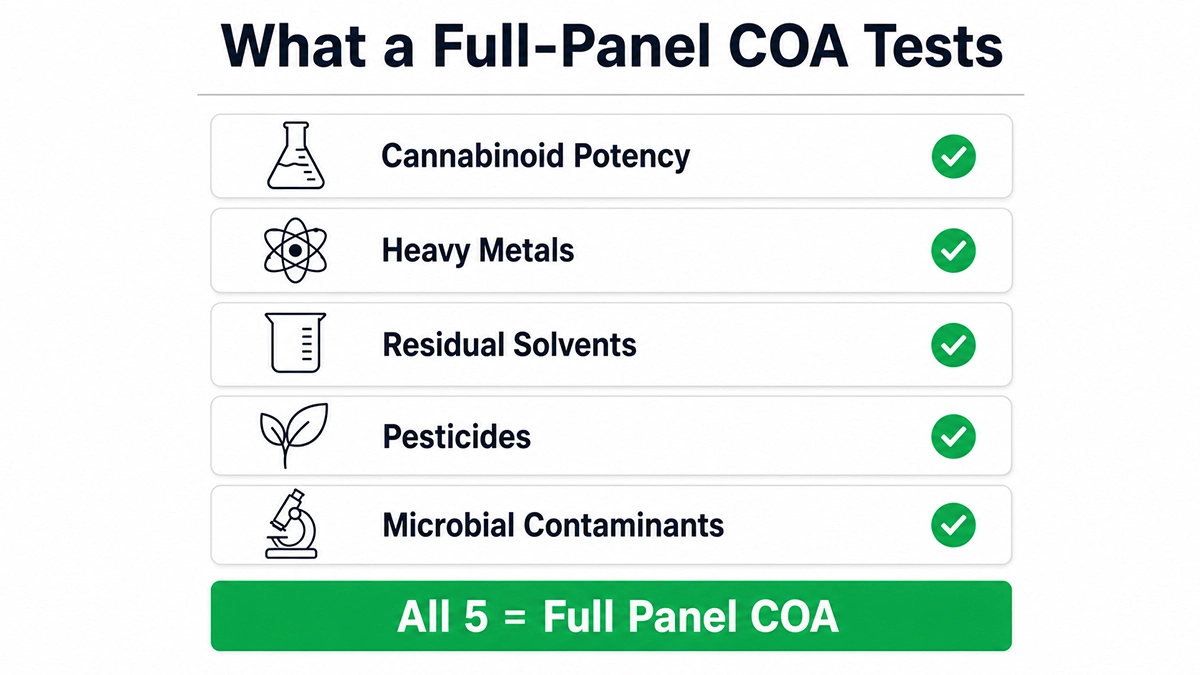
A complete COA covers five types of testing. Some brands only test for potency and skip the rest. That's not good enough. Here's what each panel checks and why you should care.
1. Cannabinoid Potency
This is the panel you'll see on every COA. It lists every cannabinoid detected in the product with concentrations in milligrams per gram (mg/g) or as a percentage.
What to look for:
- Does the cannabinoid profile match the label? If the product says "THCP + Delta-8 + CBN + HHC," all four should appear on the potency panel. If one is missing or at trace levels, the formula isn't what they're claiming.
- Delta-9 THC below 0.3%. This is the legal threshold under the 2018 Farm Bill. The COA should show the exact Delta-9 concentration. If it's above 0.3%, the product isn't federally compliant.
- Total cannabinoid content. Add up all cannabinoids. The total should roughly match the product's stated capacity. A "2-gram" vape with only 1,200mg of total cannabinoids has 800mg of something else (terpenes, carrier oils, or filler).
- "ND" (Not Detected) vs. "LOQ" (Limit of Quantitation). ND means the cannabinoid wasn't found. If the product claims to contain a cannabinoid and the COA shows ND, there's a problem.
2. Heavy Metals
Tests for lead, arsenic, cadmium, and mercury. These can enter the oil from contaminated hemp soil, extraction equipment, or (for HHC products) the metal catalysts used in hydrogenation.
What to look for:
- All four metals should be listed: Pb (lead), As (arsenic), Cd (cadmium), Hg (mercury)
- Results should be "ND" or below action limits. Action limits vary by state but are typically measured in parts per million (ppm) or micrograms per gram (ug/g).
- This panel is especially critical for HHC products because the hydrogenation process uses palladium or platinum catalysts. If the manufacturer didn't purify properly, traces can remain.
3. Residual Solvents
Tests for leftover chemicals from the extraction process: butane, propane, ethanol, hexane, isopropanol, and others.
What to look for:
- All common solvents should be tested, not just one or two
- Results should be ND or below USP 467 limits (the pharmaceutical standard for residual solvents)
- Butane and propane are common in live resin extraction. They're not dangerous at trace levels, but they should be below limits.
4. Pesticides
Tests for agricultural chemicals that may have been used on the hemp crop. Common targets include myclobutanil, bifenazate, chlorpyrifos, and dozens of others.
What to look for:
- A comprehensive panel tests for 60+ pesticide compounds. If the COA only tests for 5-10, it's a limited screen.
- All results should be ND or below action limits
- Pesticides are a supply-chain issue. Even if the manufacturer is careful, contaminated hemp from the farm can carry residues through extraction.
5. Microbial Contaminants
Tests for bacteria (E. coli, Salmonella), mold, yeast, and other biological contaminants.
What to look for:
- Total aerobic count, total yeast and mold count, should be below limits (typically <10,000 CFU/g for aerobic, <1,000 CFU/g for yeast/mold)
- Specific pathogens: E. coli and Salmonella should be "Not Detected" (zero tolerance)
- Microbial contamination is more common in flower products but can occur in concentrates if manufacturing conditions are poor.
How to Verify a COA Is Real
Some brands create fake COAs. Here's how to check:
- Check the lab name. The COA should identify the testing laboratory by name, address, and license number. Google the lab. It should be a real, accredited facility.
- Look for ISO 17025 accreditation. This is the international standard for testing laboratories. Most legitimate cannabis testing labs hold this accreditation.
- Match the batch number. The COA should have a batch/lot number that matches what's printed on your product packaging. If the numbers don't match, the COA may not be for your specific product.
- Check the date. COAs have a testing date. If the COA is from 2 years ago and the product claims to be new, something's off. COAs should be relatively recent.
- Verify with the lab directly. Most accredited labs have a verification portal on their website where you can enter the COA number and pull up the original report. If the brand's COA doesn't match the lab's records, it's fake.
- Look for a QR code. Many labs include a QR code that links directly to the verified report. Scan it and confirm it leads to the lab's domain.
Red Flags on a COA
- Potency-only testing. If the COA shows cannabinoid content but no contaminant panels (metals, solvents, pesticides, microbials), the brand is cutting corners on the most important safety tests.
- No lab name or accreditation number. A document without lab identification isn't a COA. It's a graphic design project.
- Batch numbers don't match. The COA should correspond to the specific product batch you purchased.
- "In-house testing." The whole point of third-party testing is independence. If the manufacturer tested their own product, there's no verification.
- Suspiciously perfect results. Real lab results have slight variations. If every single test shows exactly 0.000 for every contaminant, the report may be fabricated.
- PDF hosted on a random domain. Legitimate COAs are hosted on the lab's website or the brand's official COA page. If it's on a free file-sharing site, be skeptical.
How VapeCityUSA Products Are Tested
Every hemp-derived cannabinoid product sold at Vape City USA comes from brands that publish comprehensive third-party COAs:
- Mellow Fellow / Arvida Labs: Full-panel testing for every batch. COAs available at mellowfellow.fun/pages/testing. Tests include potency, pesticides, heavy metals, residual solvents, and microbials.
- Uplift CBD Co: Third-party tested with COAs available on request. Potency and contaminant panels for all Knockout Blend products.
- Geek THCX: Lab-tested with COAs available. Cannabinoid potency verified for CB9A + THCP content.
We don't carry products from brands that skip testing or only test for potency. If you can't find a COA for a product on our site, contact us and we'll provide it.
Frequently Asked Questions
Do I need to read a COA before every purchase?
Not necessarily, but you should check it at least once per brand. If a brand consistently publishes comprehensive COAs with clean results, you can trust their future products. If you're trying a new brand, always check before buying.
What does "full panel" testing mean?
Full panel means all 5 test categories: cannabinoid potency, heavy metals, residual solvents, pesticides, and microbial contaminants. "Partial" testing usually means potency-only, which skips the safety panels.
Can a product pass potency testing but fail a contaminant test?
Yes. The cannabinoid content could be exactly what the label says, but the product could still contain pesticides, heavy metals, or residual solvents above safe limits. Potency and safety are separate questions.
What labs should I look for?
Reputable cannabis testing labs include SC Labs, ProVerde Laboratories, KCA Laboratories, ACS Laboratory, and Kaycha Labs (among others). All hold ISO 17025 accreditation and are licensed in their operating states.
Browse all hemp and THC products at Vape City USA. Every product is third-party lab tested. Adults 21+ only.
These statements have not been evaluated by the FDA. These products are not intended to diagnose, treat, cure, or prevent any disease.