WARNING: Products on this page contain hemp-derived THC and are intoxicating. For adults 21+ only. They will fail a drug test. Check your state's laws before purchasing.
Updated September 30, 2026. We expanded this guide to cover live rosin, sauce and wax alongside the original live resin and distillate comparison.
The short version
Live resin is extracted from hemp or cannabis that was frozen right after harvest instead of dried and cured. Freezing keeps the terpenes, flavonoids and minor cannabinoids that normally evaporate during drying, so the oil tastes and smells close to the living plant.
Distillate is the opposite approach. The crude extract gets refined until it's a single cannabinoid at 90 to 99% purity. That process destroys the plant's own terpenes, so producers add terpenes back afterwards, either cannabis-derived (CDT) or botanical (BDT).
Live rosin reaches a similar place to live resin without any chemical solvent. The frozen material is washed in ice water to make hash, then pressed with heat. It's the most expensive of the three because the yield is low.
Two words that confuse this comparison constantly: sauce is a live resin variant that separates into a terpene-rich liquid with cannabinoid crystals suspended in it, and wax isn't an extraction method at all. It's a texture.
All five compared
| Extract | Starting material | Method | Terpenes | Relative cost |
|---|---|---|---|---|
| Distillate | Dried, cured plant | Solvent, then distillation to 90 to 99% purity | Stripped, then added back (CDT or BDT) | Lowest |
| Live resin | Fresh-frozen plant | Hydrocarbon solvent, cold | The plant's own, kept intact | Middle |
| Live sauce | Fresh-frozen plant | Live resin, left to separate | Highest of the group | Middle to high |
| Live rosin | Fresh-frozen plant | Ice water hash, then heat and pressure. No solvent | The plant's own, kept intact | Highest |
| Wax, badder, shatter | Either | Not a method. A texture of a finished extract | Depends on the extract | Depends |
Live resin vs distillate
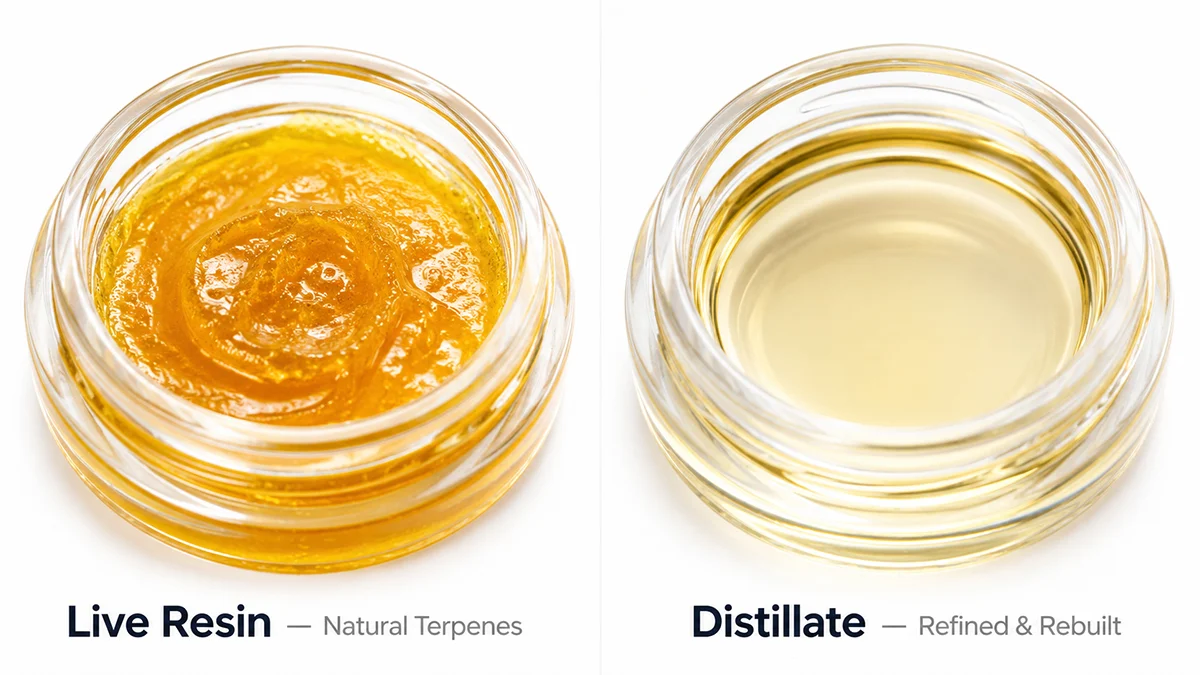
This is the comparison most people actually mean, and the honest answer is that neither one wins outright. They're built for different things.
Distillate wins on potency per gram. Refining to 90% and above means more cannabinoid in the same volume of oil. If the number on the label is what you care about, distillate is the higher number almost every time.
Live resin wins on flavor and on the shape of the effect. Terpenes carry the taste and the aroma, and they also interact with cannabinoids in what's usually called the entourage effect. A live resin cart tastes like the strain it came from. A distillate cart tastes like whatever terpenes were added back, which is why two distillate carts with the same strain name on the box can taste noticeably different.
Distillate wins on price. It yields more usable oil per pound of input and the process is easier to scale, so it's cheaper to make and cheaper to buy.
One thing worth clearing up: live resin is not weaker. It reads lower on a lab report because part of the oil is terpenes rather than cannabinoid, but most people find a terpene-rich extract feels fuller at the same dose, not milder.
Live resin vs live rosin
Both start from fresh-frozen material and both keep the plant's own terpenes. The difference is entirely in how the oil comes out.
Live resin uses a hydrocarbon solvent, usually butane or propane, run cold and then purged. Live rosin uses no solvent at all: the frozen material is washed in ice water to collect the trichomes as hash, and that hash is pressed between heated plates.
Live rosin costs more, often a lot more, for two reasons. The yield per pound is lower, and it demands better starting material because there's no chemical step to clean up a mediocre harvest. If you want a solventless product, rosin is the one. If you want most of that terpene character at a price that makes sense for an everyday cart, live resin is the practical choice, and it's what nearly every hemp disposable on the market uses.
Live resin vs sauce
Sauce, sometimes written live sauce or sold as HTFSE, is not a separate extraction. It's live resin that has been allowed to separate into two parts: a thick, terpene-heavy liquid and crystalline cannabinoid sitting in it.
The appeal is terpene content. Sauce carries more of it than standard live resin, so the flavor is louder. The trade-off is that the cannabinoid percentage on the label drops, and the consistency is wetter, which matters if you're handling it rather than buying it pre-filled in a cart.
Live resin vs wax
This one comes up constantly and the premise is off. Wax describes how an extract looks and feels, not how it was made. Shatter is glassy and brittle, badder and budder are soft and whipped, wax is somewhere between. All three can be made from cured material or from fresh-frozen material.
So the real question is what went into it. A wax made from fresh-frozen plant is live resin wax and behaves like live resin. A wax made from dried, cured plant is not live, and it will have lost terpenes during the drying. Check for the word "live" on the label, not the texture.
Resin vs live resin
Drop the word "live" and you're talking about something else entirely, and the confusion here is worth untangling because the two products have almost nothing in common.
In everyday use, resin most often means the dark residue that builds up inside a pipe or a rig after repeated use. It's combustion leftovers. It isn't a product anyone sells and it isn't what a cart contains.
The other meaning is cured resin, an extract made the same way as live resin but from plant that was dried and cured first rather than frozen. It's a legitimate product. It simply lost a share of its terpenes during the drying, which is exactly the loss live resin exists to avoid.
So when a label says live resin, "live" is carrying the whole meaning. It tells you the plant went into the freezer rather than the drying room.
Telling them apart before you buy
You usually can't judge a cart by looking at it, so the label and the lab report do the work.
- Look for "fresh-frozen" or "live" on the packaging. Producers who freeze their material say so, because it costs them more to do it. Silence usually means distillate.
- Check the terpene line on the COA. A live resin extract shows a real terpene percentage and a named profile. Distillate shows a very high single-cannabinoid number and either no terpene panel or one that reads as an additive.
- Read the cannabinoid number in context. A cart testing in the high 90s is almost certainly distillate. That isn't a mark against it, it just tells you what you're getting.
- CDT on the box is a middle option. It means distillate with cannabis-derived terpenes added back, not live resin.
- Color tells you very little. Both can run from pale gold to dark amber depending on the strain and the purge, so don't buy on appearance.
If a seller can't produce a current COA for the exact batch, that's the answer to every other question you were going to ask.
Full spectrum vs live resin
These aren't competing categories, which is why the comparison feels slippery. Full spectrum describes what's in the oil: the complete range of cannabinoids and terpenes from the plant rather than one isolated compound. Live resin describes how the oil was made.
Live resin is almost always full spectrum, because keeping the whole profile intact is the entire point of freezing the plant. Distillate is the opposite: by design it's a single cannabinoid, so it starts out as the narrowest possible spectrum and only broadens if terpenes are added back.
CDT vs BDT terpenes
When a producer adds terpenes back into distillate, they come from one of two places.
CDT means cannabis-derived terpenes, pulled from the plant itself. They're expensive and they taste closest to the real thing, which is why CDT distillate sits between plain distillate and live resin on both flavor and price.
BDT means botanical-derived terpenes, sourced from other plants. Limonene from citrus smells and tastes the same whichever plant it came from, so BDT can be convincing, but the blend is reconstructed rather than captured and it rarely matches a strain's full complexity.
If a cart lists terpenes but doesn't say which kind, it's usually BDT.
Which one should you buy?
- You want the most cannabinoid for your money: distillate.
- You want the cart to actually taste like the strain: live resin.
- You want maximum flavor and don't mind a lower cannabinoid number: sauce.
- You want no solvent used at any point and will pay for it: live rosin.
- You're new to this: start with live resin. It's the middle of the range on price and the easiest to judge, because if a live resin cart tastes flat, something's wrong with it.
Live resin products at Vape City USA
Every Mellow Fellow product uses live resin extraction. The Uplift CDT line uses distillate with cannabis-derived terpenes added back, which lands between the two.
- Mellow Fellow 4ml Live Resin Disposable: the flagship, 10 mood blends, fresh-frozen extraction, no battery needed.
- Mellow Fellow Duo Cart 4ml: two 2ml live resin carts in one pack, so you can compare two blends. Lowest cost per gram of the four.
- Mellow Fellow 2ml Live Resin Cart: a single 510-thread cart if you already own a battery.
- Mellow Fellow 1ml Live Resin Disposable: the smallest way in, good for working out which blend suits you.
- Uplift Knockout CDT: a THCP blend with cannabis-derived terpenes.
- Geek THCX GT6000: 6g of CB9A and THCP with live resin terpenes.
See every format side by side on our Mellow Fellow live resin page, or go straight to our live resin carts and live resin disposables. Everything across our hemp and THC range is third-party lab tested and sold to adults 21 and over only.
Frequently asked questions
Is live resin stronger than distillate?
Not by percentage. Distillate is refined to 90% and above, while live resin usually tests lower because terpenes make up part of the oil. Most people report that live resin feels fuller at the same dose, but the number on the lab report will favor distillate.
What is the difference between live resin and distillate?
Starting material and processing. Live resin is extracted from plant that was frozen immediately after harvest, so the original terpenes survive. Distillate is refined from dried, cured plant down to a single cannabinoid, which destroys the terpenes, and they're added back afterwards.
Is live resin better than distillate?
For flavor and for a fuller, more rounded effect, yes. For raw cannabinoid content per gram and for price, distillate wins. Neither is better in every way.
What is the difference between live resin and live rosin?
Solvent. Live resin is extracted with a hydrocarbon solvent like butane; live rosin uses only ice water, heat and pressure. Rosin costs more and needs higher-grade starting material.
Is wax the same as live resin?
No, and they aren't really comparable. Wax is a texture that a finished extract can have. It can be made from fresh-frozen material, in which case it's live resin wax, or from cured material, in which case it isn't live at all.
What is live sauce?
Live resin that has separated into a terpene-rich liquid with cannabinoid crystals in it. It carries more terpenes than standard live resin and usually shows a lower cannabinoid percentage as a result.
What is the difference between CDT and BDT?
CDT terpenes are extracted from cannabis. BDT terpenes come from other plants, like citrus or pine. CDT tastes closer to the original strain and costs more. When a label says "terpenes" without specifying, it's usually BDT.
Why does live resin cost more than distillate?
Freezing and cold storage add cost before extraction even starts, the process runs cold and slow, and the yield per pound of plant is lower. Distillate scales more easily, so it's cheaper per gram.
Is distillate safe to vape?
Properly made and properly tested distillate is a refined, clean product. What matters is the lab report, not the extraction type: check for a current COA covering potency, residual solvents, pesticides and heavy metals. Buy from sellers who publish one.
This product is derived from hemp and contains less than 0.3% Delta-9 THC in compliance with the 2018 Farm Bill. This product has not been evaluated by the FDA. It is not intended to diagnose, treat, cure, or prevent any disease.