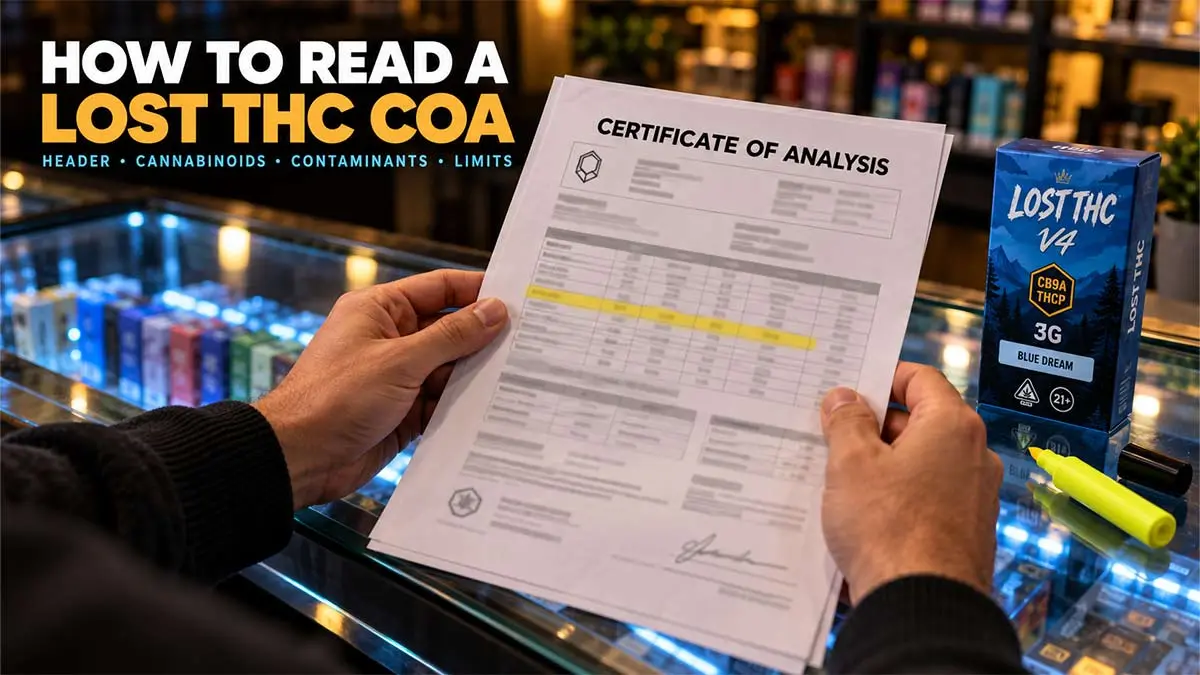
To read a Lost THC COA, check four things in order: the header, the cannabinoid table, the contaminant panels and the reporting limits. Each one answers a different question about the sample the lab tested. This guide walks through one real report. It's the KCA Laboratories report for the Fruity Pebz OG strain of Lost THC V4 CB9A + THC-P Disposable 3G, batch LTLRV425-01.
We also cover the older reports for Lost THC V2 7.5g Live Resin Disposable Vape, which look different. For a general checklist that fits any hemp vape, see our guide to reading a hemp vape COA. This article sticks to the Lost THC reports and is for adults 21+ only.
Key Takeaways
- The V4 Fruity Pebz OG report lists Delta-9 THCP at 47.1% and Delta-8 THC at 33.6%, with total Delta-9 THC not detected.
- Delta-9 THCP and Delta-9 THC are different molecules, so read each row by its exact name.
- The V4 reports (batch LTLRV425-01) cover heavy metals, pesticides, mycotoxins, residual solvents and microbials.
- The older V2 reports are cannabinoid-only, and the KCA ones say "Batch: Not Specified".
- A COA describes one tested sample. It doesn't describe effects, safety or legal status.
Two Lost THC lines, two reports
The two Lost THC products we carry have different paper trails. This table shows the headline figures exactly as the reports print them.
| Detail | Lost THC V4 CB9A + THC-P Disposable 3G | Lost THC V2 7.5g Live Resin Disposable Vape |
|---|---|---|
| Lab | KCA Laboratories | KCA Laboratories and PharmLabs San Diego |
| Report date | September 2025 | July 2024 (KCA), November 2024 (PharmLabs) |
| Batch on report | LTLRV425-01 | Not Specified on the KCA reports |
| Delta-9 THCP | 45.8 to 47.1% | 1.81 to 2.22% (KCA), 5.18 to 5.59% (PharmLabs) |
| Delta-8 THC | 33.1 to 33.8% | 76.4 to 77.6% (KCA), 80.18 to 83.91% (PharmLabs) |
| Total Delta-9 THC | ND on all six | ND on KCA; PharmLabs lists total THC at 0.06% |
| Panels | Cannabinoids plus five contaminant panels | Cannabinoids only |
The report titles differ from our product names. The V2 reports are titled "LOST THC RAINBOW EDITION 7.5g Disposable" and the V4 reports "LOST THC Live Resin 3g Disposable". Match a report to a product by strain and date, not by title.
Start with the report header
The header sits at the top of page one. On the Fruity Pebz OG report it names the client as Lost Distribution, the lab as KCA Laboratories and the batch as LTLRV425-01. It also gives a sample ID and an expiration date of August 14, 2027. The sample arrived August 28, 2025, and the cannabinoids were tested September 12, 2025.
Check three things. The batch should match the code on your pack. The dates should fit the product's age. The lab should be one you can look up. Our guide to checking a Lost THC pack covers the pack side.
KCA's own site lists a PJLA ISO/IEC 17025 accreditation and the same KDA hemp license number the report prints, P_0058. ISO/IEC 17025 is an international standard for accrediting testing labs.
Reading the cannabinoid table
Page two holds the cannabinoid table. Each row is one compound, with a result and the lab's limits.
- Percent: the compound's weight as a share of the sample. Fruity Pebz OG shows Delta-9 THCP at 47.1%.
- mg/g: milligrams per gram. One percent equals 10 mg/g, so 47.1% is 471 mg/g.
- LOD (limit of detection): the lowest amount the method can see.
- LOQ (limit of quantitation): the lowest amount the method can measure with confidence.
- ND (not detected): the method found nothing at or above its limit. It doesn't prove the compound is absent at every amount.
The report lists total cannabinoids at 83.4%. The remainder isn't itemized, so the rows won't add up to 100%.
What total Delta-9 THC means
KCA prints the formula on its reports: Total Delta-9 THC = Delta-9 THCA × 0.877 + Delta-9 THC. The 0.877 factor adjusts for the mass THCA loses when heat turns it into Delta-9 THC. On the Fruity Pebz OG report, that total is ND.
Delta-9 THCP is not Delta-9 THC
Delta-9 THCP, Delta-9 THC and Delta-8 THC are three separate compounds, and each gets its own row.
On the Fruity Pebz OG report, Delta-9 THCP reads 47.1% and Delta-8 THC reads 33.6%. Total Delta-9 THC reads ND. Across all six V4 reports, Delta-9 THCP runs 45.8 to 47.1% and total Delta-9 THC is ND on every one.
CB9A isn't a line item on any of the six V4 reports. A compound the lab doesn't list as an analyte is one the report can't speak to.
The contaminant panels
The pages after the cannabinoid table cover contaminants. The V4 reports run five panels, each with its own method.
- Heavy metals (ICP-MS): arsenic, cadmium, lead and mercury, all not detected.
- Pesticides (LC-MS/MS and GC-MS/MS): not detected for every analyte listed.
- Mycotoxins: aflatoxins B1, B2, G1 and G2 plus ochratoxin A, not detected.
- Residual solvents (HS-GC-MS): not detected for every analyte listed.
- Microbials (PCR and plating): not detected, apart from two lines marked "<RL".
RL stands for reporting limit. A "<RL" line means the result fell below the lowest level the lab reports, so there's no number to read. On our worked example, the total aerobic count reads <RL. On the Bloo Dream report, yeast and mold does.
The appendix at the end lists the limit for every analyte. An ND or <RL tells you more once you know how low the test could see.
What a COA can't tell you
- One sample, one batch. A report covers the sample tested. A pack with a different batch code isn't covered by LTLRV425-01.
- Moisture content. The V4 reports mark it as not tested.
- Older V2 reports. They are cannabinoid-only. The KCA ones, dated July 2024, say "Batch: Not Specified", so they can't be tied to a batch code on a pack.
- Effects, safety and legality. A COA measures. It doesn't say how a product feels, whether it suits you or whether it's legal where you live.
Federal hemp rules also change on November 12 and December 11, 2026, and states set their own rules. A lab report can't answer that for you.
In the 90 days to October 28, 2026, roughly 3 in 4 Lost THC units ordered from Vape City USA were the 7.5g line. That line has the cannabinoid-only reports.
A real example of an inconclusive result
The PharmLabs San Diego reports for Blue Zushi and GG#4, reported November 27, 2024, show how a lab handles a result it can't call. The Delta-9 THC row reads "UI", short for unidentified.
A lab note explains why. The Delta-9 result is inconclusive because other cannabinoids interfered in GC-MS/MS, and no interference showed up by HPLC. The same reports print THCA at 0.07% and total THC at 0.06%, which fits the formula, since 0.07 × 0.877 is about 0.06.
The lab didn't write ND or invent a number. Read UI as "not determined", never as "none".
Lost THC COA questions
What is a Lost THC COA?
A Lost THC COA is a third-party lab report on a sample of a Lost THC product. The reports we've read come from KCA Laboratories and PharmLabs San Diego, and they list cannabinoid results. The V4 reports add contaminant panels.
Does ND for total Delta-9 THC mean the vape has no THC?
No. ND means total Delta-9 THC wasn't detected on that report. Delta-9 THCP and Delta-8 THC are different compounds with their own rows, and the report lists them separately.
Why does a V2 report say Batch Not Specified?
The July 2024 KCA reports for the V2 line don't name a batch. They apply to the sample tested, but you can't match them to a batch code on a pack.
What does UI mean on a PharmLabs report?
UI means unidentified. On the Blue Zushi and GG#4 reports, the lab marked Delta-9 THC as inconclusive because of interference from other cannabinoids in GC-MS/MS. Read it as not determined.
Does the V4 report list CB9A?
No. CB9A isn't an analyte on any of the six V4 reports we read, so those reports can't confirm or rule out anything about it.
Lab reports describe what was measured in one sample. They aren't health advice, and this article makes no claim about effects or legal status. For adults 21+ only. Browse the Lost THC lineup, read our Lost THC vapes guide or the V2 vs V4 review.
These statements have not been evaluated by the FDA. These products are not intended to diagnose, treat, cure, or prevent any disease.