
The Short Answer
THCA doesn't get you high in its raw form. You could hold raw THCA flower in your hand, eat it in a salad, or dissolve it in a smoothie, and you wouldn't feel any psychoactive effects. But the moment you apply heat, everything changes.
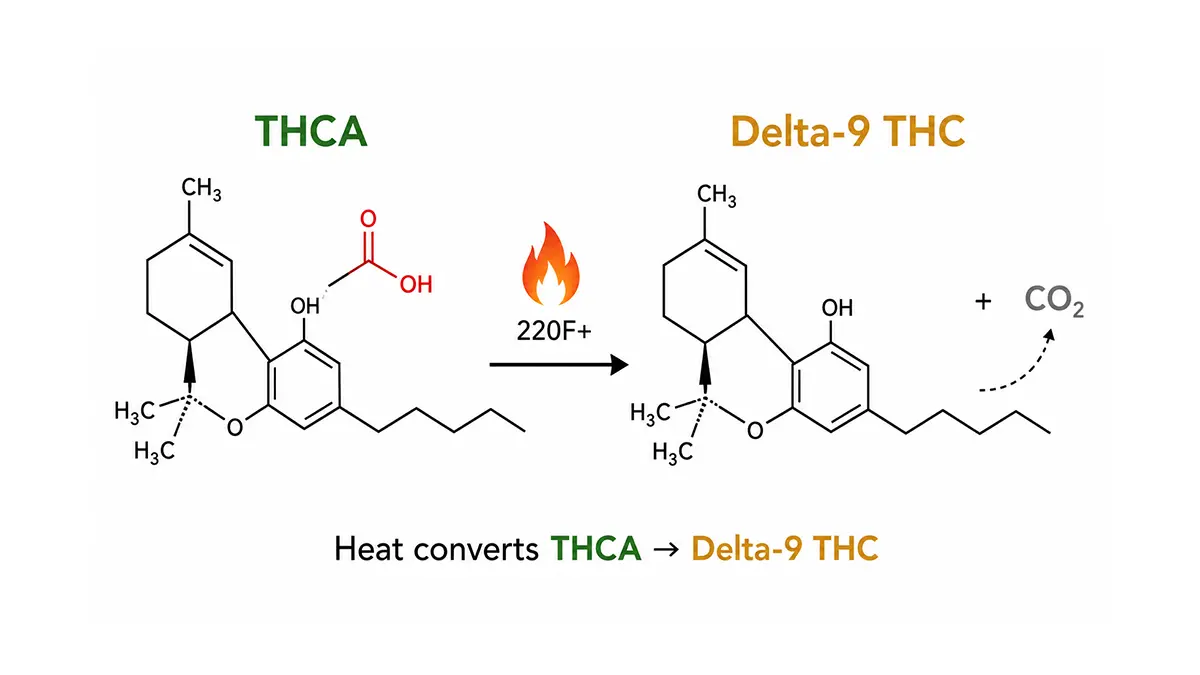
When you vape, smoke, or dab THCA, a chemical reaction called decarboxylation kicks in. Heat strips a carboxyl group (COOH) from the THCA molecule, and it converts directly into Delta-9 THC. That's the same compound responsible for the high in traditional cannabis. So yes, vaped THCA absolutely gets you high, and the effects are essentially identical to Delta-9.
This distinction between raw THCA and heated THCA is the entire reason THCA products exist in the legal hemp market. It's also the most misunderstood part. Let's break it down.
What Is THCA?
THCA (tetrahydrocannabinolic acid) is a naturally occurring cannabinoid found in raw cannabis and hemp plants. It's the most abundant cannabinoid in living hemp flower. Every cannabis plant that eventually produces THC starts by producing THCA first.
In its natural state, THCA has a three-dimensional shape that doesn't fit well into your brain's CB1 receptors. Those are the receptors responsible for the psychoactive "high." Because THCA can't bind effectively to CB1, it doesn't produce intoxication. It's like having a key that's too big for the lock.
But THCA isn't useless in raw form. Early research suggests it may have anti-inflammatory, neuroprotective, and anti-nausea properties. Some people juice raw cannabis specifically for these potential benefits without any psychoactive effects.
THCA loses its carboxyl group when heated, becoming Delta-9 THC
Decarboxylation: The On Switch
Decarboxylation is a fancy word for a simple process: heat removes a COOH group from the THCA molecule, converting it into Delta-9 THC. This happens automatically whenever you vape, smoke, dab, or cook with THCA.
The conversion starts at around 220F (104C) and becomes more efficient at higher temperatures. Most vape devices operate between 350F and 450F, which is more than enough for near-complete conversion. When you take a puff from a THCA vape cartridge, the oil passes through the heated coil, decarboxylation happens in milliseconds, and what enters your lungs is Delta-9 THC vapor.
Here's how different consumption methods affect the conversion:
- Vaping (350-450F): Near-complete conversion. Efficient delivery. Effects within 1-5 minutes. This is the most common way to consume THCA.
- Smoking (600F+): Complete conversion, but combustion also destroys some cannabinoids and creates byproducts. Still effective, just less efficient than vaping.
- Dabbing (500-700F): Very high conversion rate. Intense, fast-acting effects. Best for experienced users.
- Edibles (must be cooked): Raw THCA doesn't convert in your stomach. You need to decarb it first by heating in an oven (usually 230-250F for 30-40 minutes), then add it to food. Effects take 30-90 minutes to kick in but last much longer.
- Raw consumption: No decarboxylation, no high. Period.
What Does the High Feel Like?
Since vaped THCA converts to Delta-9 THC, the effects are what you'd expect from traditional THC:
- Euphoria and mood elevation
- Physical relaxation
- Altered perception of time
- Increased appetite
- Heightened sensory experiences (music, food, visuals)
- Potential anxiety or paranoia at high doses
The intensity depends on the THCA concentration, your tolerance, the device you're using, and how deeply you inhale. A product with 25% THCA content will produce effects comparable to a 25% THC cannabis product after decarboxylation.
Onset: 1-5 minutes when vaped. Peak effects at 15-30 minutes. Total duration: 2-4 hours.
This is different from milder hemp cannabinoids like Delta-8 THC, which produces about half the intensity of Delta-9. THCA (once heated) is the full-strength experience.
THCA vs. Other Cannabinoids: Potency Comparison
| Cannabinoid | Potency vs. Delta-9 | High? |
|---|---|---|
| THCA (vaped) | ~1x (converts to Delta-9) | Yes, full-strength |
| Delta-8 THC | ~0.5x | Yes, milder |
| HHC | ~0.7-0.8x | Yes, moderate |
| THCP | ~5-10x | Yes, very strong |
| CBD | 0x | No |
If you want something less intense than THCA, Delta-8 is a smoother, milder alternative. If you want something stronger, THCP products like the Uplift Knockout Blend deliver significantly more potency per puff.
Why Is THCA Legal?
This is the part that confuses people. The 2018 Farm Bill legalized hemp and hemp-derived products containing less than 0.3% Delta-9 THC by dry weight. The testing happens on the raw, unheated product.
A hemp flower with 25% THCA and 0.2% Delta-9 passes the legal test because only 0.2% of its weight is Delta-9 at the time of testing. The fact that heating converts all that THCA into Delta-9 isn't addressed in the current federal framework.
It's a loophole, and regulators have noticed. In November 2025, President Trump signed the Continuing Appropriations Act, which rewrites the federal definition of hemp. Starting November 12, 2026, the law shifts from Delta-9-only testing to a "total tetrahydrocannabinols" standard measured after decarboxylation. THCA will count toward the 0.3% threshold. Finished products face a cap of 0.4mg total THC per container. That means most current THCA flower and concentrates won't qualify as legal hemp after that date.
At the state level, roughly 12 states have already banned or restricted THCA products. Several others require total-THC testing that effectively closes the loophole today.
Check your state's specific regulations before purchasing. Federal law currently says THCA is legal, but that window is closing fast. For a full breakdown, see our state-by-state legal guide.
Will THCA Show Up on a Drug Test?
Yes. If you've vaped, smoked, or dabbed THCA, you've consumed Delta-9 THC. Your body metabolizes it the same way and produces the same THC-COOH metabolites that standard drug tests detect.
There's no difference between consuming THCA and consuming Delta-9 from a drug testing perspective. None. A urine test can't tell whether the THC came from a dispensary joint, a hemp-derived THCA vape, or a Delta-8 gummy. They all produce the same metabolites.
Detection windows after THCA use:
- Urine: 3-30 days depending on use frequency
- Blood: 1-2 days (occasional), up to 7 days (heavy use)
- Saliva: 1-3 days
- Hair: Up to 90 days
If you have a drug test coming up, don't use THCA products. Full details in our drug test guide.
How to Try THCA Safely
If you're new to THCA, here are some practical tips:
- Start low. Take one small puff and wait 10-15 minutes before taking another. THCA converts to full-strength Delta-9, so it's not a "light" cannabinoid.
- Pick a comfortable setting. Don't try it for the first time right before work or driving. Stay home, have snacks and water nearby.
- Check the COA. Every legitimate THCA product comes with a third-party Certificate of Analysis showing cannabinoid content, pesticide screening, and heavy metal testing. If there's no COA, don't buy it.
- Use quality hardware. Devices with ceramic or mesh coils deliver cleaner, smoother vapor. Products like the Geek THCX GT6000 ($34.99) use dual mesh coils and a CB9A + THCP blend that includes THCA-related cannabinoids in a 6-gram device.
- Know your state laws. Legal federally, but some states restrict THCA using total-THC calculations.
Browse all hemp and THC products at Vape City USA. Every product is third-party lab tested and ships with COAs. Adults 21+ only.
These statements have not been evaluated by the FDA. These products are not intended to diagnose, treat, cure, or prevent any disease.