The Honest Answer
There are no long-term safety studies on HHC. That's the starting point, and it's important to acknowledge it clearly. HHC has been available commercially since around 2021, and most of what we know about its safety comes from short-term user reports, basic pharmacological understanding, and extrapolation from THC research.
What we can say: HHC interacts with the same CB1 and CB2 receptors as Delta-9 THC. Its effects are milder (roughly 70-80% of Delta-9 potency). It's been used by millions of people over the past several years with no documented cases of serious injury or death attributable to HHC itself. But "no documented harm in a few years" is not the same as "proven safe."
This article breaks down what we know, what we don't, and how to make informed decisions if you choose to use HHC products.
What Is HHC and How Is It Made?
HHC (hexahydrocannabinol) is a hydrogenated form of THC. The process adds hydrogen atoms to the THC molecule under high pressure using a metal catalyst (typically palladium or platinum). American chemist Roger Adams first performed this reaction on THC in 1944.
HHC occurs naturally in hemp seeds and pollen, but only in trace amounts. All commercial HHC is produced through hydrogenation. The starting material is CBD-derived THC from legal hemp, which makes the final product hemp-derived.
The hydrogenation process itself is well-established in food science (it's how vegetable oil becomes margarine). However, applying it to cannabinoids introduces specific concerns:
- Catalyst residues: Palladium and platinum catalysts must be completely removed from the final product. Incomplete purification can leave metal traces behind. This is the #1 safety concern specific to HHC manufacturing.
- Isomer ratios: Hydrogenation produces two HHC isomers: 9R-HHC (more active) and 9S-HHC (less active). The ratio affects potency and consistency. Reputable manufacturers target consistent isomer ratios batch to batch.
- Byproducts: Incomplete reactions can produce unintended cannabinoid byproducts. Full-spectrum testing should verify the product contains what it claims.
What the Research Says
Published research on HHC is limited compared to Delta-9 THC, CBD, or even Delta-8. Here's what exists:
- Receptor binding: HHC binds to CB1 receptors with slightly lower affinity than Delta-9. This aligns with user reports of milder effects. (Harvey, 1984; Mechoulam et al., various publications)
- Stability: Hydrogenated cannabinoids resist thermal and UV degradation better than non-hydrogenated forms. This is well-established chemistry. (Collins et al., 2023)
- Metabolization: HHC is likely metabolized via similar hepatic pathways as Delta-9, producing hydroxylated metabolites. Limited formal pharmacokinetic studies exist.
- Toxicology: No published toxicology studies specific to HHC in humans as of May 2026.
The absence of research doesn't mean HHC is dangerous. It means we're relying on structural similarity to THC (which has decades of safety data) rather than direct evidence for HHC specifically.
Known Side Effects
Because HHC acts on the same receptors as THC, its side effect profile is expected to be similar. Users and limited research suggest:
- Common: Dry mouth, red eyes, increased appetite, mild dizziness, altered time perception
- Occasional: Anxiety or paranoia (less common than with Delta-9, but possible at high doses)
- Dose-dependent: Sedation, impaired coordination, difficulty concentrating
These are the same side effects associated with THC-family cannabinoids generally. Nothing unique to HHC has been reported in user surveys or case reports.
The Real Safety Risks (Product Quality, Not the Molecule)
The biggest safety concern with HHC products isn't the cannabinoid itself. It's product quality. An untested HHC vape from an unknown brand could contain:
- Heavy metal residues from the hydrogenation catalyst (palladium, platinum, nickel)
- Residual solvents from extraction (ethanol, butane, hexane)
- Pesticides carried over from the hemp source material
- Unknown byproducts from incomplete conversion reactions
- Vitamin E acetate or cutting agents added to thin the oil (responsible for the 2019 EVALI vape crisis, which was caused by black-market additives, not cannabinoids)
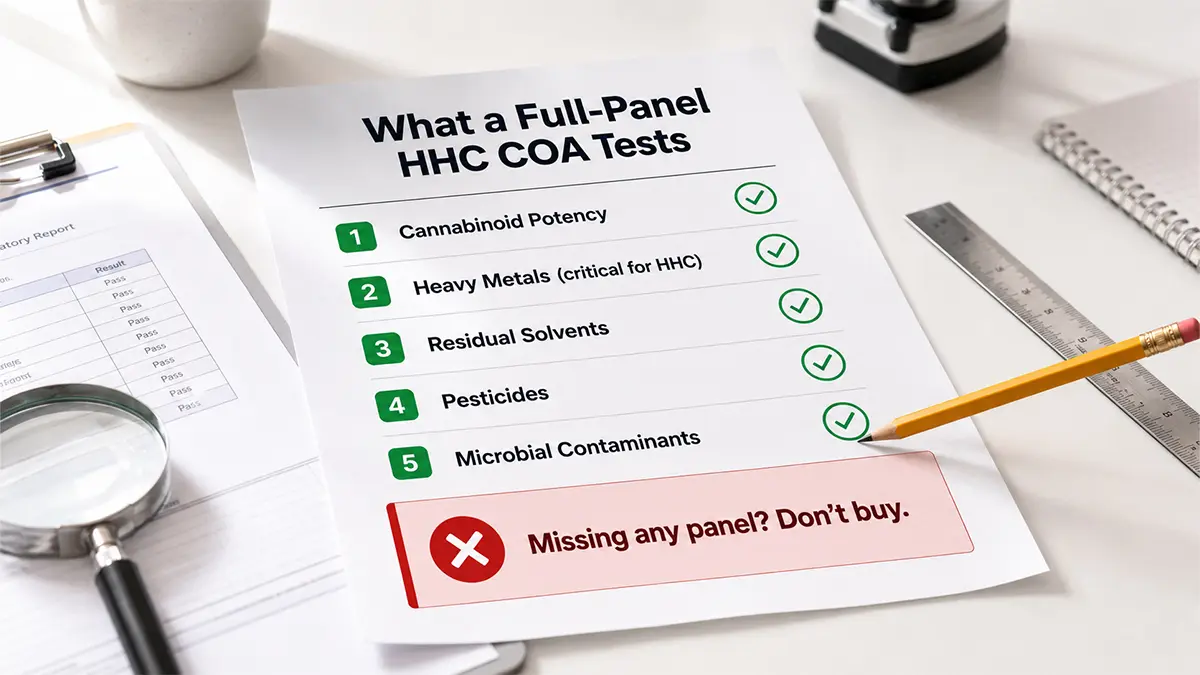
Every single one of these risks is eliminated by buying from brands that publish comprehensive third-party Certificates of Analysis (COAs). A proper COA tests for:
- Cannabinoid potency: confirms the product contains what it claims
- Heavy metals: critical for HHC specifically due to metal catalysts in production
- Residual solvents: tests for leftover extraction chemicals
- Pesticides: tests for agricultural contaminants in the hemp
- Microbial contaminants: tests for bacteria, mold, yeast
If a brand doesn't publish COAs, or if the COA only shows potency (without contaminant panels), don't buy the product. For a step-by-step guide on reading COAs, see our upcoming COA reading guide.
Red Flags to Avoid
Watch for these warning signs when shopping for HHC products:
- No COA available. Non-negotiable. If they don't test, don't buy.
- COA only shows potency. Potency-only COAs skip the contaminant panels that matter most for HHC.
- Wildly cheap pricing. Quality HHC production costs more than basic Delta-8 because of the hydrogenation process. If the price seems too good to be true, corners were probably cut.
- Vague labeling. "Hemp extract" or "cannabinoid blend" without listing specific compounds is a red flag.
- No brand website or contact info. Legitimate brands are transparent about who they are and how to reach them.
- Claims of "100% natural HHC." Commercial HHC is synthesized through hydrogenation. Claiming it's "natural" is misleading. Natural trace amounts exist in hemp, but that's not what's in your vape.
HHC Products at Vape City USA
Every product containing HHC at Vape City USA comes from brands that publish full-panel COAs:
- Mellow Fellow: HHC appears in 9 of 10 mood blends. Pharmacist-formulated, Arvida Labs manufactured. Full COAs available on mellowfellow.fun/pages/testing. 4ml disposable ($39.99) | Duo cart ($34.99) | 2ml cart ($27.99)
- Uplift CBD Co: HHC is part of the Knockout Blend formula (THCP + Delta-8 + CBN + HHC). COAs available. CDT disposable ($29.99) | BDT disposable ($24.99)
We don't carry standalone HHC isolate products because multi-cannabinoid blends deliver a better, more balanced experience through the entourage effect.
Frequently Asked Questions
Is HHC safer than Delta-8?
Neither has long-term safety data. Both interact with the same receptors. The key difference: HHC production uses metal catalysts, which creates an additional contamination risk if purification is inadequate. Delta-8 production uses acid catalysts, which can leave different byproducts. For both, the safety question is really about product quality, not the molecule.
Can HHC cause lung damage?
No published evidence links HHC specifically to lung damage. The 2019 EVALI crisis was caused by Vitamin E acetate in black-market THC cartridges, not by any specific cannabinoid. Buying from brands that test for contaminants and don't use cutting agents is the best way to minimize inhalation risks.
Is HHC natural?
HHC exists naturally in hemp seeds and pollen in trace amounts. However, all commercial HHC is produced through hydrogenation. It's a semi-synthetic cannabinoid: the starting material is natural (hemp CBD), but the final product is chemically modified.
Can I overdose on HHC?
No fatal cannabinoid overdoses have been documented in medical literature (for any cannabinoid, including THC). Taking too much HHC can cause intense anxiety, paranoia, nausea, dizziness, and impaired coordination. These effects are uncomfortable but not medically dangerous for healthy adults. If you take too much, stop using, drink water, and wait it out in a comfortable setting.
For a full comparison of HHC with Delta-8, see our HHC vs Delta-8 comparison guide. For an overview of all hemp cannabinoids, visit the cannabinoid encyclopedia.
Browse all hemp and THC products at Vape City USA. Every product is third-party lab tested. Adults 21+ only.
These statements have not been evaluated by the FDA. These products are not intended to diagnose, treat, cure, or prevent any disease.